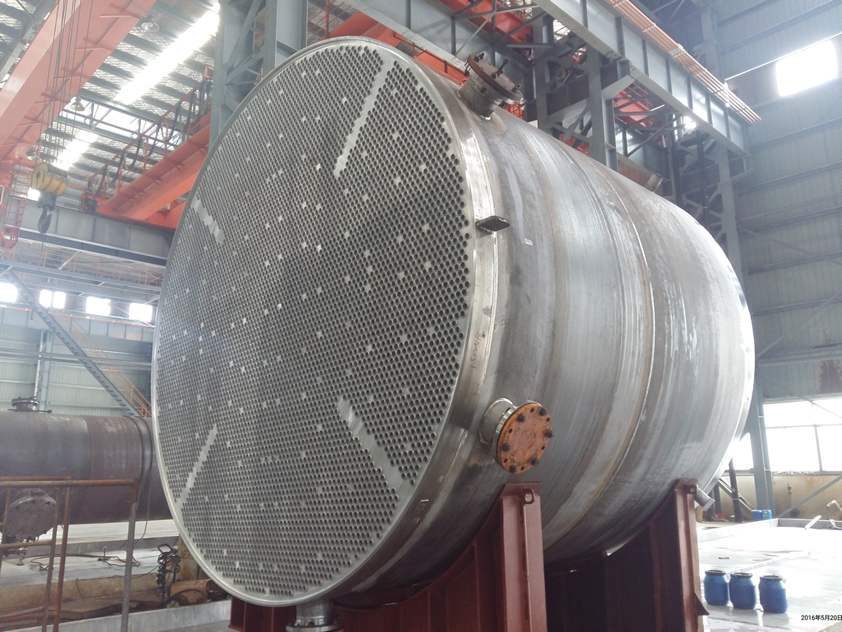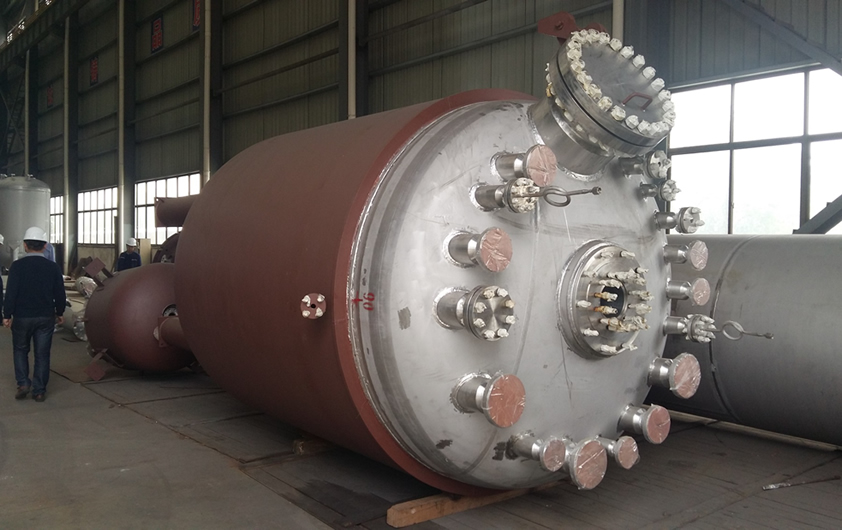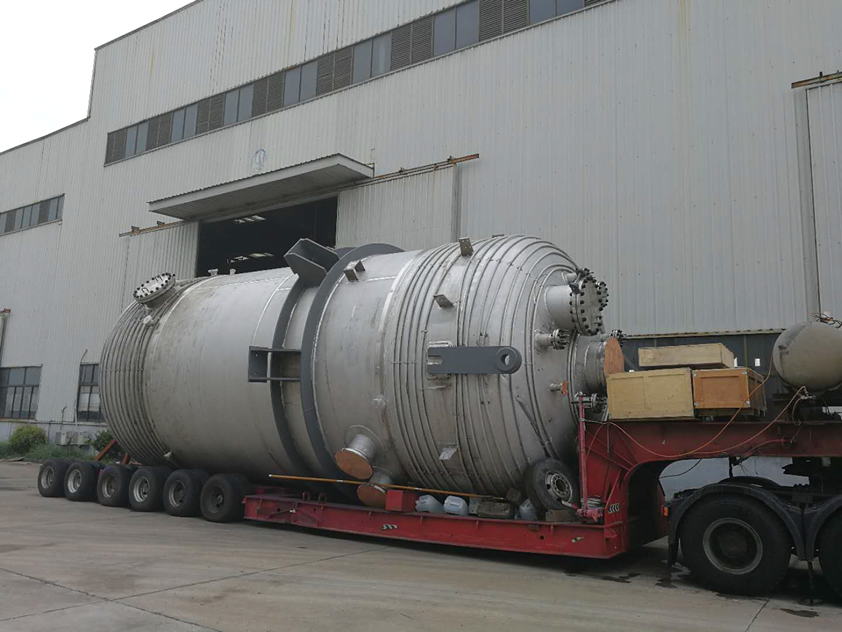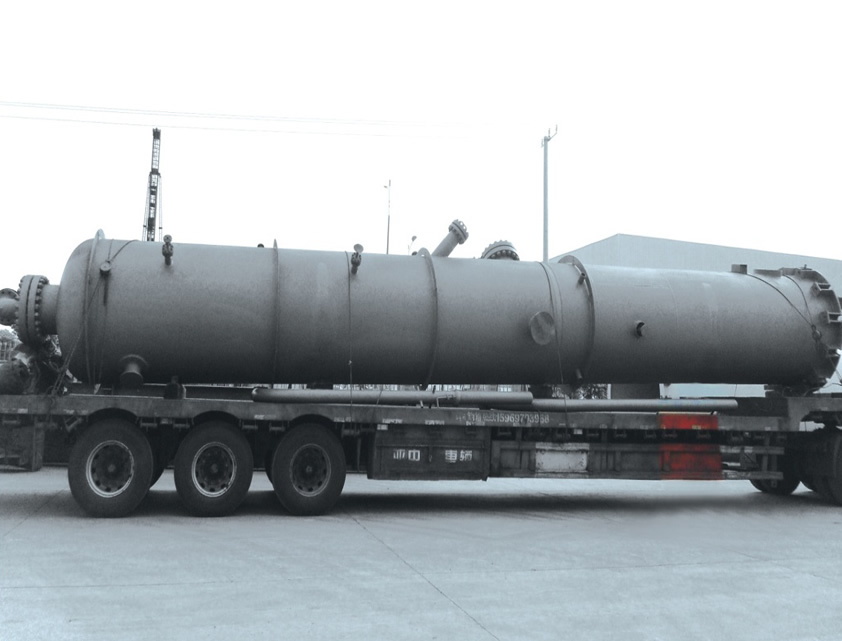
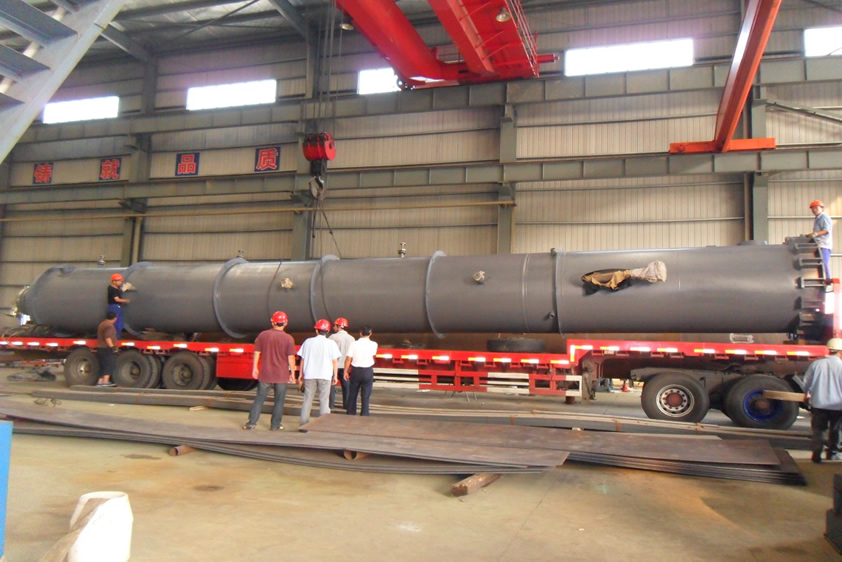
Crude benzene hydrogenation pre-reactor
No.: Demei-M-R-005
- Design Pressure: 2.0 - 4.0 MPa
- Design Temperature: 260 - 280 °C
- Reactor Type: Vertical Fixed-Bed Reactor
- Equipment Type: Vertical fixed-bed reactor
- Operating Temperature: Inlet: 180 - 240 °C; Bed Hot Spot ≤ 280 °C
- Operating Pressure: 2.0 - 3.8 MPa
- Liquid Hourly Space Velocity (LHSV): 1.0 - 10.0 h⁻¹ (Liquid-phase: 2-4 h⁻¹ common)
- Hydrogen-to-Oil Ratio (Vol.): 300:1 - 600:1
- Feed Bromine Index: < 30 g Br₂/100g
- Catalyst Type: Ni-Mo/Al₂O₃ or Pd/Al₂O₃
- Bed Support: Bottom: Large ceramic balls (Φ25mm) → Medium/Small balls (Φ6/12mm) → Catalyst → Top balls
- Key Internals: Inlet distributor, fouling baskets, inter-bed quench hydrogen injection & mixing system, outlet collector.
- Temperature Monitoring: Axial (multiple layers) and radial (multiple points) thermocouples.
- Shell Material: Base Layer: SA-387 Gr.11/12 (1¼Cr-½Mo Steel)Cladding/Lining: SA-240 Type 321/347 Stainless Steel (3-6mm thick)
- Internals Material: 304, 321, 347 SS or Incoloy 800H
- Hardness Requirement: Weld HAZ hardness ≤ 200 HB
- Design Life: ≥10 years
The crude benzene hydrogenation pre-reactor is a critical upstream equipment in the crude benzene refining process for producing benzene, toluene, and xylene (BTX). Its core function is to selectively catalyze the hydrogenation of the raw material under relatively mild conditions (typically 200-280°C and 2.5-4.0 MPa). It primarily removes easily polymerizable and coking-prone unsaturated hydrocarbons (such as styrene and indene) from the crude benzene, hydrogenating them into corresponding saturated hydrocarbons. Simultaneously, it partially removes impurities such as sulfur, nitrogen, and oxygen, preventing these impurities from causing coking and catalyst poisoning in the subsequent main reactor or separation system, thus ensuring the long-term stable operation of the entire plant. This reactor typically uses a fixed-bed configuration with palladium or nickel-based catalysts, and its efficient operation is a key prerequisite for achieving safe, stable, long-term, full-capacity, and optimal performance of the entire hydrogenation process.
- Selective Hydrogenation of Polymerizable Impurities: Under relatively mild conditions (low temperature and pressure), it selectively hydrogenates highly reactive unsaturated hydrocarbons (like di-olefins, styrene, indene) into stable saturated compounds, preventing their polymerization.
- Partial Removal of Heteroatoms: It partially removes sulfur (e.g., CS₂), nitrogen, and oxygen compounds, converting them to H₂S, NH₃, and H₂O.
- Protection of Downstream Units: Acting as the "process guardian", its fundamental purpose is to purify the feedstock. This prevents polymerization and coking of unsaturates in the downstream main reactor (which operates at higher severity) or separation systems, thereby protecting the expensive main reactor catalyst and ensuring long-term (typically 2-3+ years), safe, stable, and efficient operation of the entire unit.
| Stage | Method & Requirements | Details |
|---|---|---|
| 1. Primary Transport Mode | Road Transport (Oversized Load) | The reactor is a single, non-dismantlable large item. Transported via hydraulic trailers or multi-axle modular trailers with a "Oversize Load Permit". Route surveys are mandatory; obstacles (wires, toll booths) may need temporary removal or raising. |
| 2. Equipment Packaging | Bare Packaging + Protection | The main vessel is shipped "bare" but with extensive protection: • Flanges sealed with protective covers (plywood + waterproof tape). • Entire unit covered with tarpaulin to prevent corrosion from rain/salt during transit. • Secured on steel support skids. |
| 3. Internals Packaging | Separate Packaging | Internal components like catalyst support grids, quench pipes are removed and packed separately: • Packed in fumigated wooden crates with moisture-proof lining. • Critical parts use vacuum aluminum-plastic bags + nitrogen inerting, with desiccant added. |
| 4. Documentation | Waterproof & Attached | Certificates, inspection reports (e.g., NB/T 47013 RT films), loading diagrams are sealed in double-layer waterproof bags and securely attached to the skid with clear labels ("Documents Enclosed"). |
| 5. Loading/Unloading & Securing | Professional Handling & Lashing | • Handling: Using large crawler cranes or Self-Propelled Modular Transporters (SPMT). For skidding, nylon plates are used between reactor and skids. • Securing: On the trailer, the vessel sits on rubber pads, secured with wire ropes and tensioners via four or more lashing points, with side chocks to prevent movement. |
| 6. Transport Safety | Escorted & Controlled | • Transport vehicles equipped with GPS, fire screens, static grounding reels, and fire extinguishers. • Drivers require hazardous materials transport certification. • Speed limit ≤ 50 km/h, minimum turning radius ≥ 25 m, lashing checked before crossing bridges. • Travel may be restricted at night or during peak hours. |
| 7. Spent Catalyst Transport | Hazardous Waste Transport | Spent catalyst is hazardous waste (HW50 category). Must be transported by licensed contractors in sealed UN-standard steel drums or tankers under a hazardous waste electronic manifest system. Vehicles must meet specific standards. |
| 8. Site Handover | Joint Inspection | Upon arrival, a joint inspection by the supervisor, manufacturer, and installer is conducted to check for damage, dimensions, documents, and accessories. An equipment handover certificate is signed. The reactor should be moved under a temporary weather shelter promptly. |