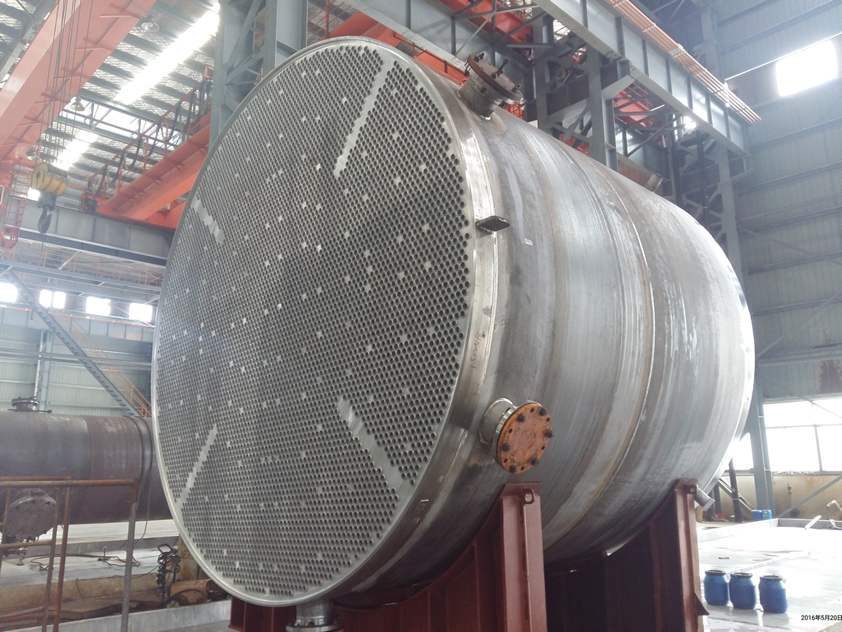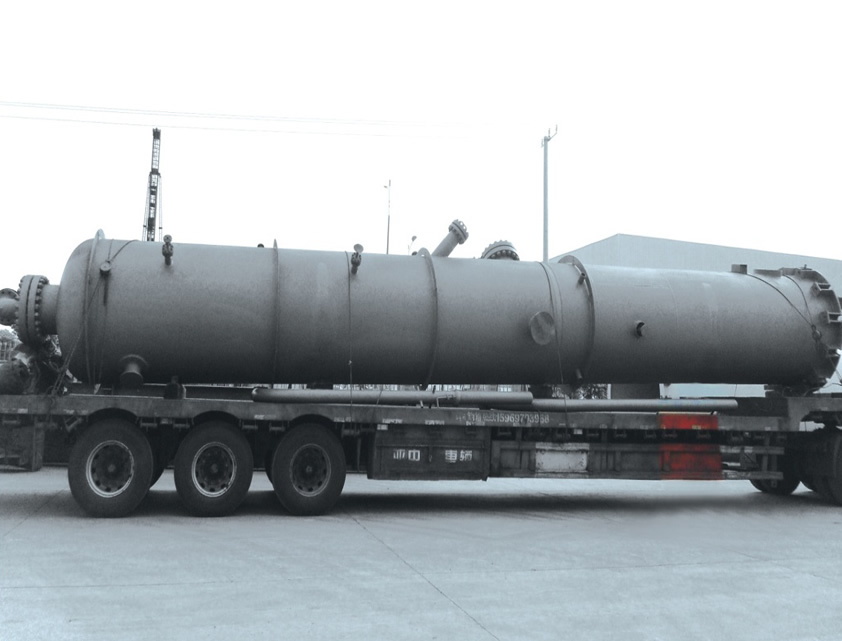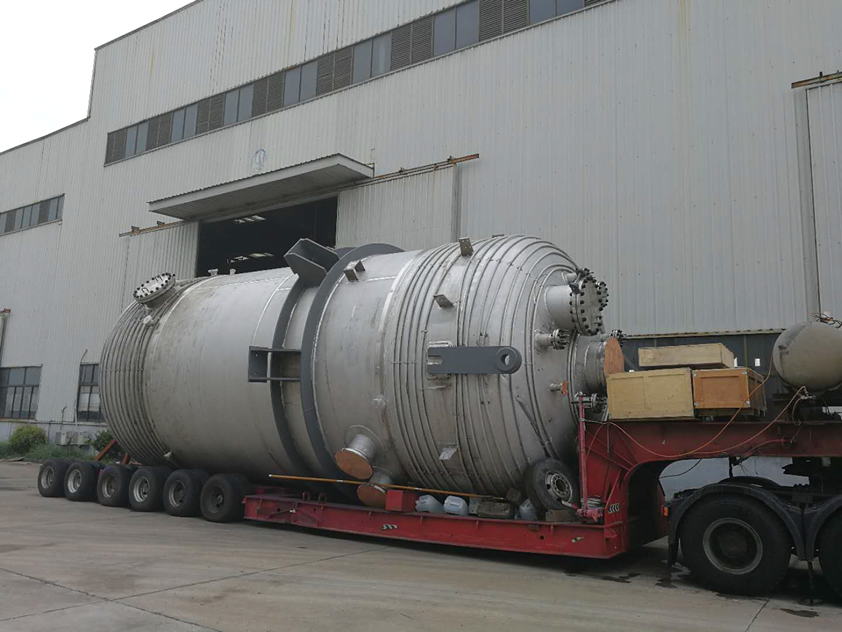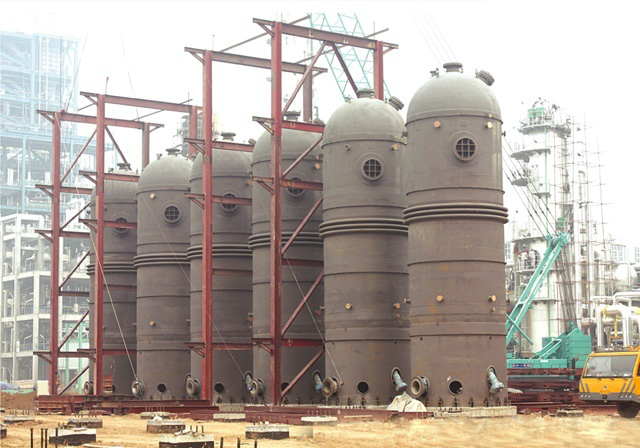
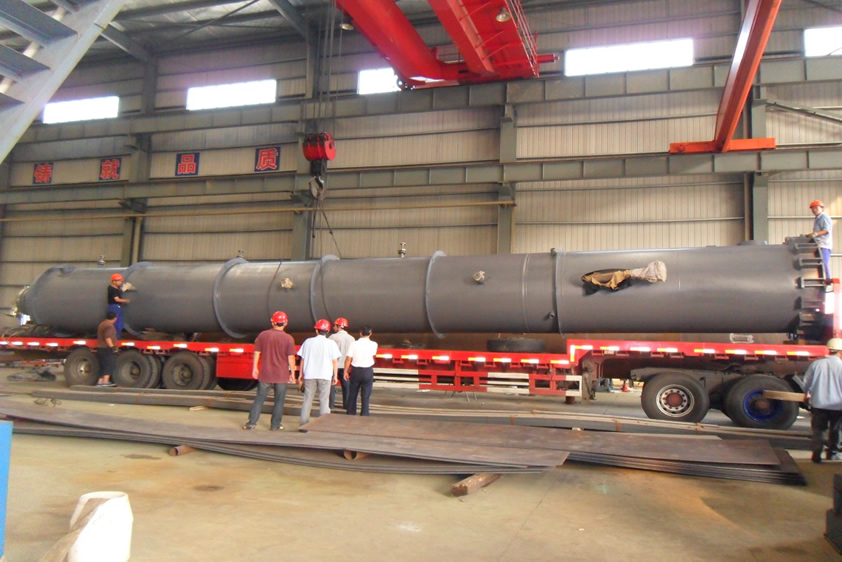
Ethylene glycol hydrogenation reactor
No.: Demei-M-R-006
- Reactor Type: Trickle Bed Fixed-Bed Reactor
- Operating Temperature: 110 – 140 °C
- Operating Pressure: 1.0 – 2.5 MPa (G).
- Liquid Hourly Space Velocity (LHSV): 3.3 – 8.3 h⁻¹
- H₂ to Carbonyl (Aldehyde) Molar Ratio: Significantly > Stoichiometric ratio (>10:1).
- Gas-to-Liquid Volume Ratio (Standard): 100:1 to 500:1.
- Hydrogen Purity / Feed: High purity H₂. CO in feed gas typically maintained < 1000 ppmv within the bed, requiring a continuous vent/purge stream.
- Heat Removal: Reaction is mildly exothermic. Temperature is controlled primarily by feed/product heat exchange. Some designs incorporate internal cooling coils or external circulation.
- Design Pressure/Temperature: Design P ≈ 1.5-3.0 MPa, Design T ≈ 180-200°C
- Internal Components (Critical): 1. Inlet Distributor: Multi-level (primary & secondary) liquid/gas distribution plates or specially designed nozzles. 2. Catalyst Support: Grids, support plates, and layers of inert ceramic balls (different sizes). 3. Thermowells: Multiple points for axial/radial bed temperature monitoring. 4. Emergency Relief Device.
- Material of Construction: Stainless Steel (304, 304L, 316L).
- Catalyst Type: Nickel-based (Ni/Al₂O₃)
- Design Life: ≥5 years
The ethylene glycol hydrogenation reactor is a key purification equipment used in processes such as coal-to-ethylene glycol production and polyester recycling for purifying crude ethylene glycol. It mainly comes in two types: the first is a fixed-bed tubular reactor commonly used in the gas-phase hydrogenation of oxalate esters to produce ethylene glycol. This reactor also acts as a waste heat boiler, with boiler water in the shell side removing the reaction heat. Under conditions of 170–190°C and 1.5–2.5 MPa, a Cu/SiO₂ catalyst is used to hydrogenate dimethyl oxalate into ethylene glycol. The second type is a trickle-bed or bubble column reactor used in the liquid-phase hydrogenation refining of finished ethylene glycol. At lower temperatures (105–110°C) and pressures (0.4–0.6 MPa), a nickel-based catalyst is used for selective hydrogenation of impurities such as aldehydes in crude ethylene glycol to improve product UV transmittance and reduce aldehyde content. This reactor is a gas-liquid-solid three-phase reaction system, involving a high-temperature and high-pressure hydrogen environment. Strict control of bed temperature hotspots, catalyst lifespan, and material resistance to hydrogen embrittlement is crucial, as its efficient and stable operation directly determines whether the final ethylene glycol meets the standards for fiber-grade polyester production.
- Primary Purpose: To deeply purify crude or industrial-grade ethylene glycol (EG), specifically by removing trace impurities such as aldehydes, ketones, conjugated aldehydes, and cyclic diketones through catalytic liquid-phase hydrogenation.
- Key Objective: To significantly improve the product's Ultraviolet Transmittance (UV Value) and reduce aldehyde content, enabling the production of high-purity Fiber-Grade or Polyester-Grade Ethylene Glycol that meets stringent quality standards (e.g., GB/T 4649-2018).
- Process Location: Typically positioned downstream of product distillation columns (e.g., Dehydration Tower, Product Column, or Recovery Column) in coal-to-EG or synthetic gas-to-EG plants, treating side-stream EG cuts.
- A. Packaging Method: "Bare Packaging with Integrated Protective Framework"
- Internal Protection: The reactor interior is thoroughly cleaned, dried, and inerted with dry Nitrogen (N₂) sealed at a slight positive pressure (e.g., 0.03-0.05 MPa). All nozzles and flanges are sealed with steel blind plates (welded bolts).
- External Protection & Fixation: The vessel is wrapped in VCI (Vapor Corrosion Inhibitor) film and waterproof materials, then mounted and securely lashed (using galvanized steel wires and turnbuckles) onto a robust steel transport saddle/skid. This forms a single rigid unit to prevent rolling or tipping.
- Component Protection: External fittings (flange faces, instrument ports) are covered with custom protective caps. Auxiliary parts (internals, tools, spares) are packed separately in crates.
- Identification: Clear markings for center of gravity, lifting points, weight, dimensions, and warnings ("Fragile," "Keep Dry," "This Side Up") are applied.
- B. Transportation Mode: Multimodal Transport Based on Size/Distance
- Primary Choice - Road Transport (Domestic/Short Haul):
- Vehicle: Multi-axle hydraulic modular trailers (e.g., Goldhofer) or Self-Propelled Modular Transporters (SPMT) for heavier loads.
- Logistics: Requires detailed route survey and obtaining Over-Dimensional Load permits. Often involves escort vehicles, nighttime transport, and temporary removal of obstacles.
- Primary Choice - Sea + Road (International/Long Haul):
The reactor, secured on its skid, is transported by heavy-duty truck to the port.
It is then loaded via crane (onto a general cargo ship) or roll-on/roll-off (onto a RORO ship).
Onboard, it is securely welded and lashed to the ship's structure.
After sea voyage, it is offloaded and transported by road to the final site.
- Modular Transport: For reactors exceeding road/rail dimensional limits, they may be fabricated in sections, shipped separately, and welded on-site.
- C. Special Requirements & Monitoring
- Vibration/Shock Monitoring: Shock recorders are installed to log G-forces and angles during transit, ensuring no excessive handling occurred.
- Condition Monitoring: Nitrogen pressure is monitored to confirm the integrity of the inert seal.
- If Pre-loaded with Catalyst (Less Common, High-Risk): Treated as Dangerous Goods (UN 3190, Pyrophoric solid). Requires strict inerting (H₂ <0.5% LEL), dangerous goods placards, and firefighting equipment on the transport vehicle.
- Documentation: Essential documents accompany shipment: Packing List, Material Certificates, Nitrogen Pressure Record, Shock Recorder Report, Over-Dimensional Permits, Lashing Calculations, Dangerous Goods Declaration (if applicable), Insurance Certificates.