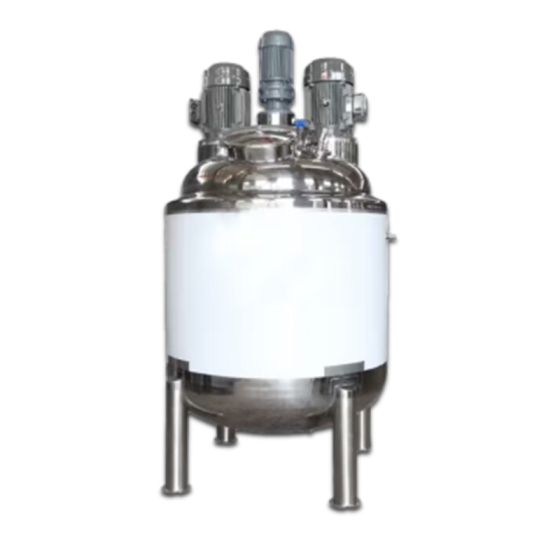
Multifunctional Dispersion Reactor
No.: Demei-M-R-010
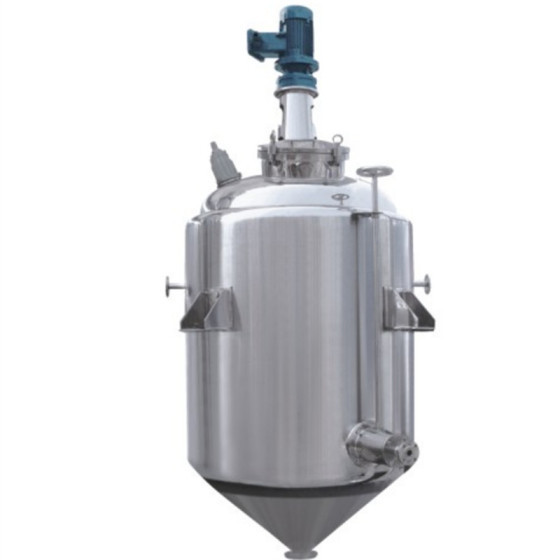
The dispersion reactor is designed to agitate and mix liquids or liquid-powder mixtures, making it suitable for batch production processes. It can be further equipped with dispersion, emulsification, heating, and cooling capabilities to meet the diverse requirements of various manufacturing workflows. The interior wall of the reactor features a mirror-polished finish, which accelerates the efficiency of material dispersion and mixing while preventing material adhesion and facilitating easy cleaning. The exterior surface is also mirror-polished, lending the equipment a sophisticated and aesthetically pleasing appearance. Characterized by its long service life, stable operation, low noise levels, simple operation, and strong adaptability, this unit serves as an ideal multi-functional device for mixing, dispersing, and related applications.
|
Model |
Dimensions (mm) |
Weight (kg) |
Number of layers |
Thickness (mm) |
Motor |
Dispersed power |
|
1000L |
Ф1100X2540mm |
885 |
Single layer |
5mm |
4P-3KW |
4P-11KW |
|
1000L |
Ф1200X2580mm |
1196 |
Double layer |
Inner layer 5mm Outer layer 4mm |
4P-3KW |
4P-11KW |
|
2000L |
Ф1400X3527mm |
1900 |
Single layer |
5mm |
4P-5.5KW |
4P-22KW |
|
2000L |
Ф1500X3529mm |
2359 |
Double layer |
Inner layer 5mm Outer layer 4mm |
4P-5.5KW |
4P-22KW |
|
3000L |
Ф1500X3725mm |
2080 |
Single layer |
6mm |
4P-7.5KW |
4P-30KW |
|
3000L |
Ф1600X3859mm |
2645 |
Double layer |
Inner layer 6mm
|
4P-7.5KW |
4P-30KW |
|
5000L |
Ф1800X4230mm |
3320 |
Single layer |
8mm |
4P-11KW |
4P-37KW |
|
5000L |
Ф1900X4250mm |
4500 |
Double layer |
Inner layer 8mm Outer layer 6mm |
4P-11KW |
4P-37KW |
-
Mixing and Dispersing Solids into Liquids – Breaking down agglomerates and distributing solid particles uniformly in a liquid medium.
-
Emulsification – Creating stable emulsions by mixing immiscible liquids (e.g., oil and water).
-
High-speed Shearing – Reducing particle size for fine dispersions (e.g., in paints, inks, and pigments).
-
Dissolving – Accelerating the dissolution of powders or granules in solvents.
-
Homogenization – Ensuring batch consistency in products like adhesives, sealants, and cosmetics.
-
Chemical Reactions – Facilitating reactions that require intense mixing and heat transfer (e.g., polymerization, condensation, hydrolysis, neutralization, crystallization).
-
Mixing Medium-to-High Viscosity Materials – Processing thixotropic materials, including color matching.
-
Lithium Battery Industry Applications – High-shear dispersion emulsification and polymer polymerization.
-
Pharmaceutical Formulations – Emulsification and homogenization of drug formulations (including suspensions).
-
Food and Consumer Product Processing – Mixing, homogenizing food ingredients, and preparing emulsions/suspensions (e.g., detergents, soaps, personal care formulations).
-
Advanced Materials Processing – Dispersing nanomaterials, battery materials, ceramics, and advanced composites.
Packaging Methods
-
Wooden Crates: Used with anti-vibration padding; export-grade/fumigated crates provide structural rigidity.
-
Steel Frames / Skid-Mounted Bases: For heavy-duty or large industrial reactors; allows forklift or crane handling.
-
Plastic Wrapping / Vacuum Sealing: For moisture protection.
-
Desiccants: Included to prevent corrosion.
-
Foam Padding / Shock-Absorbing Materials: Internal lining to prevent collision damage to the vessel surface and protect sensitive components (e.g., motors, sensors).
-
Blind Plates / Sealing Caps: Used to seal flange openings against dust, moisture, and foreign particles.
-
Anti-Corrosion Coatings / Oil Films: Applied on metal surfaces for protection.
-
Separate Packaging for Components: Detachable parts (agitators, shafts, control panels) are packed separately, clearly labeled for reassembly. Electrical/control systems are often placed in sealed boxes.
-
Labeling: Includes handling instructions (e.g., "Fragile," "Keep Upright") and lifting point marking.
-
Special Packaging (if required): Explosion-proof packaging for hazardous areas; cleanroom-compatible packaging for pharmaceutical-grade systems.
Transportation Methods
-
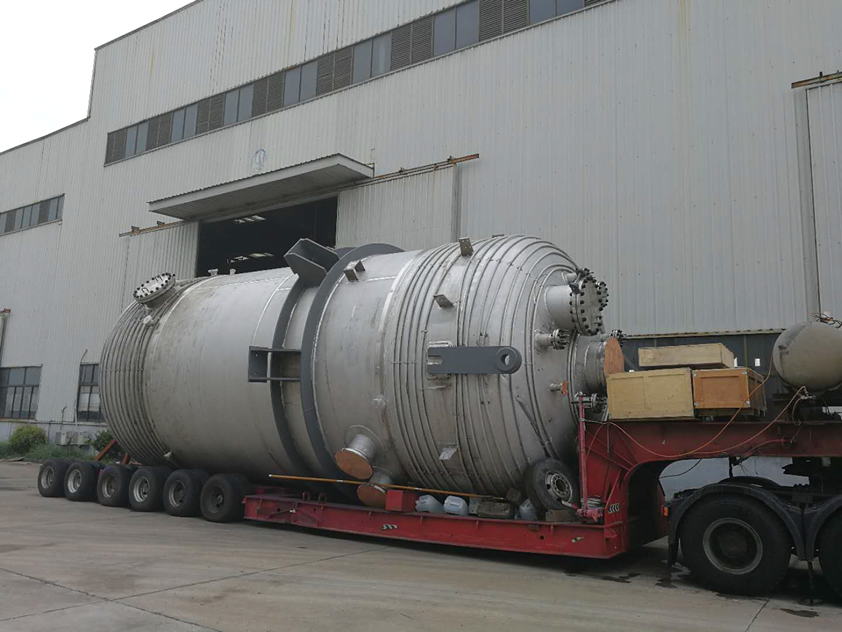
Road (Truck): For short to medium distances (≤500 km), using flatbed, enclosed trailers, or low-bed trailers for oversized/heavy reactors (>6 m or >10 tons). Air-suspension vehicles recommended; speed controlled ≤80 km/h.
-
Sea Freight: For international shipping, using 20ft/40ft containers (standard for medium reactors), open-top/flat-rack containers for oversized units, or break-bulk shipping for very large industrial reactors. FCL or LCL options available.
-
Rail: For long distances (>1000 km) or domestic/cross-border transport of large equipment; cost 20–40% lower than road transport.
-
Air Freight: Only for small benchtop/laboratory reactors, urgent small components, or spare parts (rarely used for complete vessels due to size/weight limits).
-
Inland Waterway: For coastal or riverine regions (sea freight category).